The Problem with AI IT Support Bots

Vlad Shlosberg
Founder
AI has quickly become one of the most discussed ideas in internal IT, and for understandable reasons. The promise is compelling: reduce repetitive questions, improve self-service, surface documentation faster, and give employees immediate support without increasing team workload.
For IT leaders under pressure to do more with constrained resources, that proposition is understandably attractive.
At the same time, the gap between AI as a concept and AI as a dependable service layer remains significant. Many organizations are discovering that while AI can accelerate service operations, it can also expose weaknesses that were previously easier to overlook. In that sense, the problem with AI support bots is not that they do not work. It is that they often work exactly as well as the operational environment around them allows.
That becomes clear very quickly in real-world deployments.
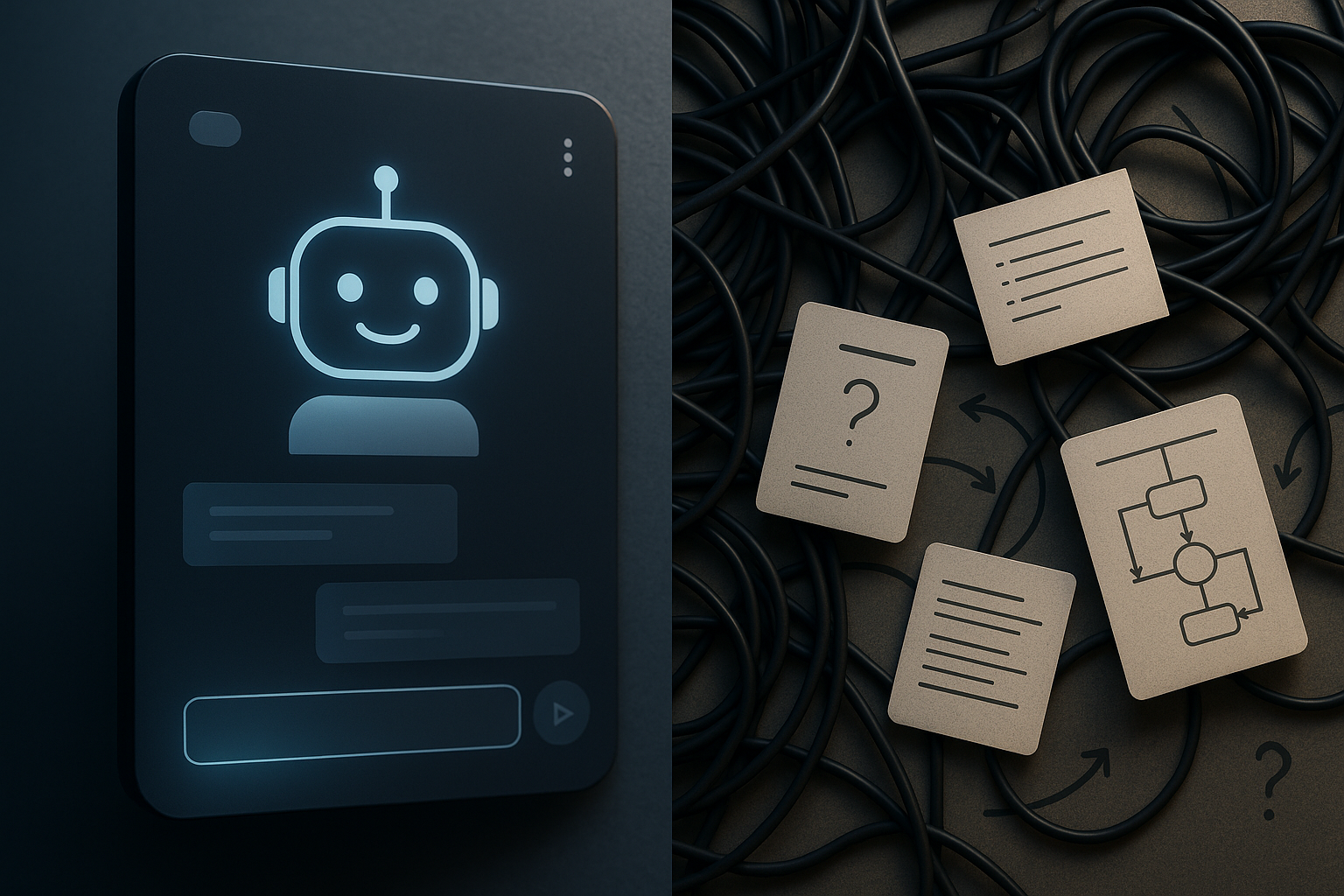
The Ideal Use Case
The ideal use case is straightforward. An employee asks a common question:
- How to access a tool
- Where to find a policy
- How to configure a device
- What steps to follow for a routine process
The AI bot retrieves the right answer from trusted sources, presents it clearly, and deflects a ticket that never needed human attention in the first place.
That is a valuable outcome, and in many cases it is achievable.
But where things become more complicated is when organizations assume that a conversational interface by itself is enough to create a reliable support experience. In practice, AI bots typically run into one of several predictable limitations.
Five Predictable Limitations
1. Knowledge Quality
If documentation is outdated, inconsistent, incomplete, or scattered across too many disconnected systems, the bot becomes a faster way to surface uncertainty. AI can summarize, retrieve, and reframe content, but it does not create operational truth. It depends on that truth already existing somewhere in a form it can use.
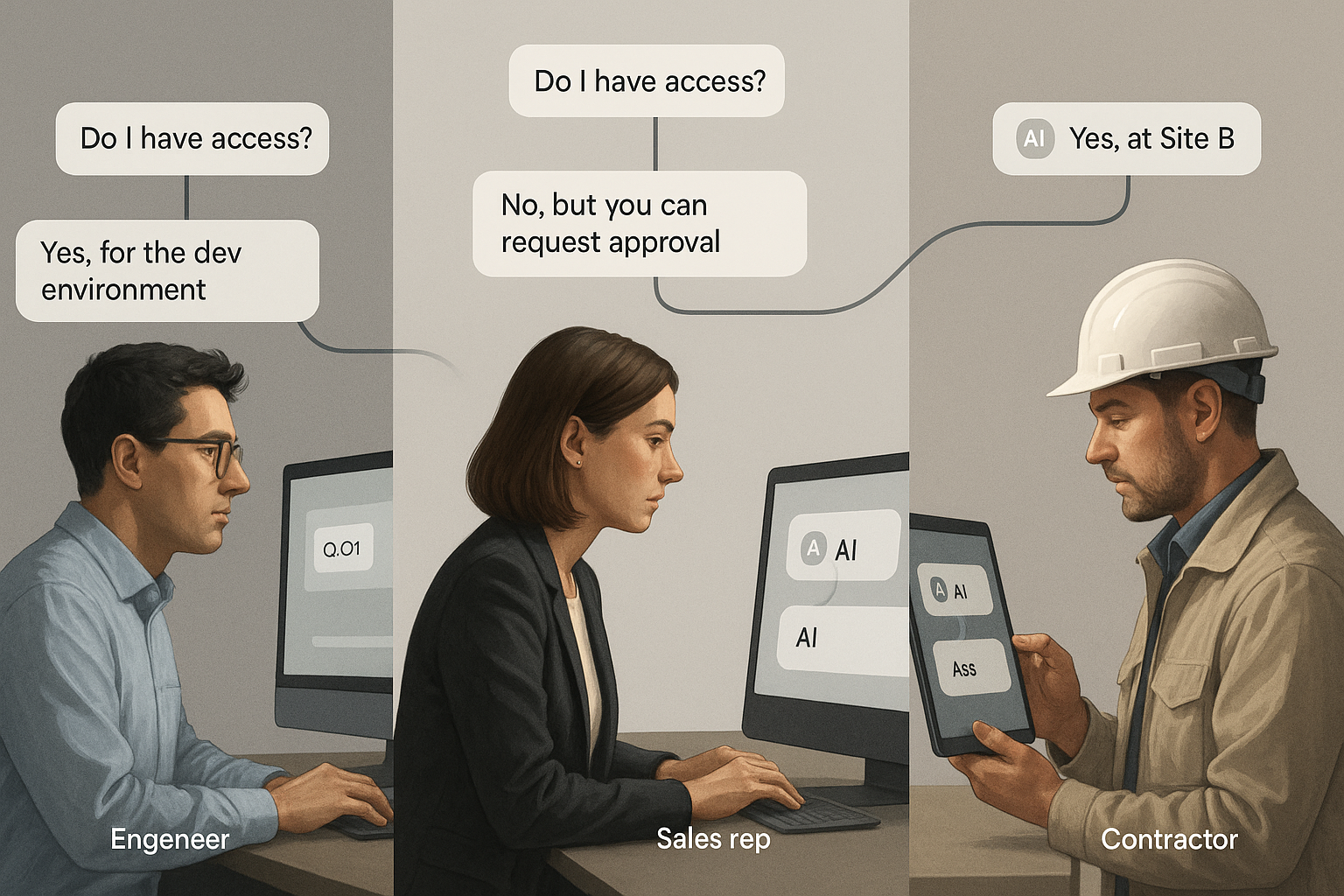
2. Lack of Context
Many IT questions are not generic, even when they appear simple. The right answer often depends on:
- Role
- Department
- Office location
- Device type
- Identity provider
- App ownership
- Licensing model
- Policy tier
A request for software access is not just a request for software access. It may require approval logic, entitlement checks, provisioning rules, or security review. Without context, AI tends to default to broadly reasonable language that may not be operationally correct.
3. Accountability
Human agents bring more than information retrieval. They bring judgment. They know when a request is sensitive, when an answer is uncertain, and when a workflow should begin instead of a paragraph being generated. AI can often sound authoritative regardless of whether that authority is warranted.
In a support context, that can be risky. An imprecise answer about Wi-Fi instructions is one thing. A wrong answer about identity access, security controls, or employee data handling is quite another.
4. Architectural Gaps
Many AI support deployments are built primarily as answer engines. They can generate useful responses, but they do not connect cleanly to the rest of the service operation. The user still has to create the ticket, request the approval, or trigger the workflow separately. In those cases, AI adds surface sophistication without materially reducing effort.
5. Post-Deployment Drift
Knowledge bases change. Systems evolve. Policies update. Without ongoing maintenance and feedback loops, AI performance can degrade over time as the underlying sources become stale or inconsistent.
Recalibrating Expectations
This is where many teams begin to recalibrate their expectations.
The strongest AI support patterns we see are not based on replacing service workflows. They are based on strengthening them. AI works well when it:
- Helps answer low-risk, repetitive questions
- Identifies the right documentation
- Gathers missing context
- Summarizes requests for agents
- Routes work more intelligently
In other words, it performs best when it acts as an operational accelerator rather than as a standalone service model.

The Right Model: Hybrid Service
That distinction is important. The goal should not be to create a bot that appears to do everything. The goal should be to make the overall support experience faster, clearer, and more effective.
For many organizations, the right model is therefore hybrid:
- AI handles knowledge retrieval and first-line conversational interaction
- If confidence is high and the issue is straightforward, the employee receives an immediate answer
- If the request requires action, sensitivity, approval, or structured workflow, the system should transition cleanly into ticketing, routing, or human review
That is where AI becomes truly useful: not as an isolated destination, but as part of a broader service architecture.
AI Reveals Operational Problems
It is also worth noting that AI often reveals rather than causes operational problems. If a bot performs poorly, the root cause may not be the model itself. It may be:
- Fragmented documentation
- Unclear ownership
- Inconsistent workflows
- Lack of trustworthy source systems
In that sense, AI maturity is inseparable from operational maturity.
The Right Questions to Ask
This is why the most thoughtful IT leaders are approaching AI support as a systems question, not just a feature question. They are asking:
- What information sources do we trust?
- Which interactions are low-risk enough to automate?
- Where should AI stop and workflow begin?
- How do we preserve confidence and accuracy over time?
- What does success actually look like in terms of reduced effort and improved resolution?
Those are the right questions.
The Future of AI in IT Support
The future of AI in IT support is real, but it is unlikely to be defined by fully autonomous bots taking over the help desk. It is more likely to be defined by organizations that embed AI thoughtfully into service operations, use it where it adds leverage, and remain disciplined about where judgment, accountability, and workflow still matter most.
In that model, AI does not replace IT. It improves the reach and responsiveness of IT.
And that is a much more durable form of progress.
See how Foqal combines AI-powered assistance with structured workflows—delivering fast, accurate answers while seamlessly routing complex requests to the right teams and systems.
Subscribe to our newsletter
Get the latest insights on IT operations, AI, and workplace productivity delivered to your inbox.
Ready to transform your support?
See how Foqal can help your team deliver faster, smarter support.
Start Free TrialRelated Articles
Why IT Teams Hate Logging Into Ticketing Systems
Discover why ticketing systems often fail and how integrating requests directly into Slack or Teams can eliminate friction while preserving IT governance.
Why IT Teams Are Replacing Jira and ServiceNow
Discover why IT teams are shifting from traditional Jira and ServiceNow interfaces to friction‑less, chat‑based experiences that keep the powerful back‑end while dramatically improving user satisfaction.
The Future of IT Onboarding: Fully Automated Day-1 Workflows
Discover how fully automated Day‑1 workflows transform onboarding from a chaotic checklist into a seamless, secure experience that boosts efficiency and showcases IT’s strategic value.