Why IT Teams Hate Logging Into Ticketing Systems

Vlad Shlosberg
Founder
For years, enterprise IT has tried to solve one very human problem with one very structured answer: if employees need help, they should go to the portal, fill out the form, and let the process begin.
On paper, that approach makes perfect sense. Ticketing systems create accountability. They establish ownership. They support reporting, triage, automation, and auditability. They make service operations legible. For IT leaders, all of that matters.
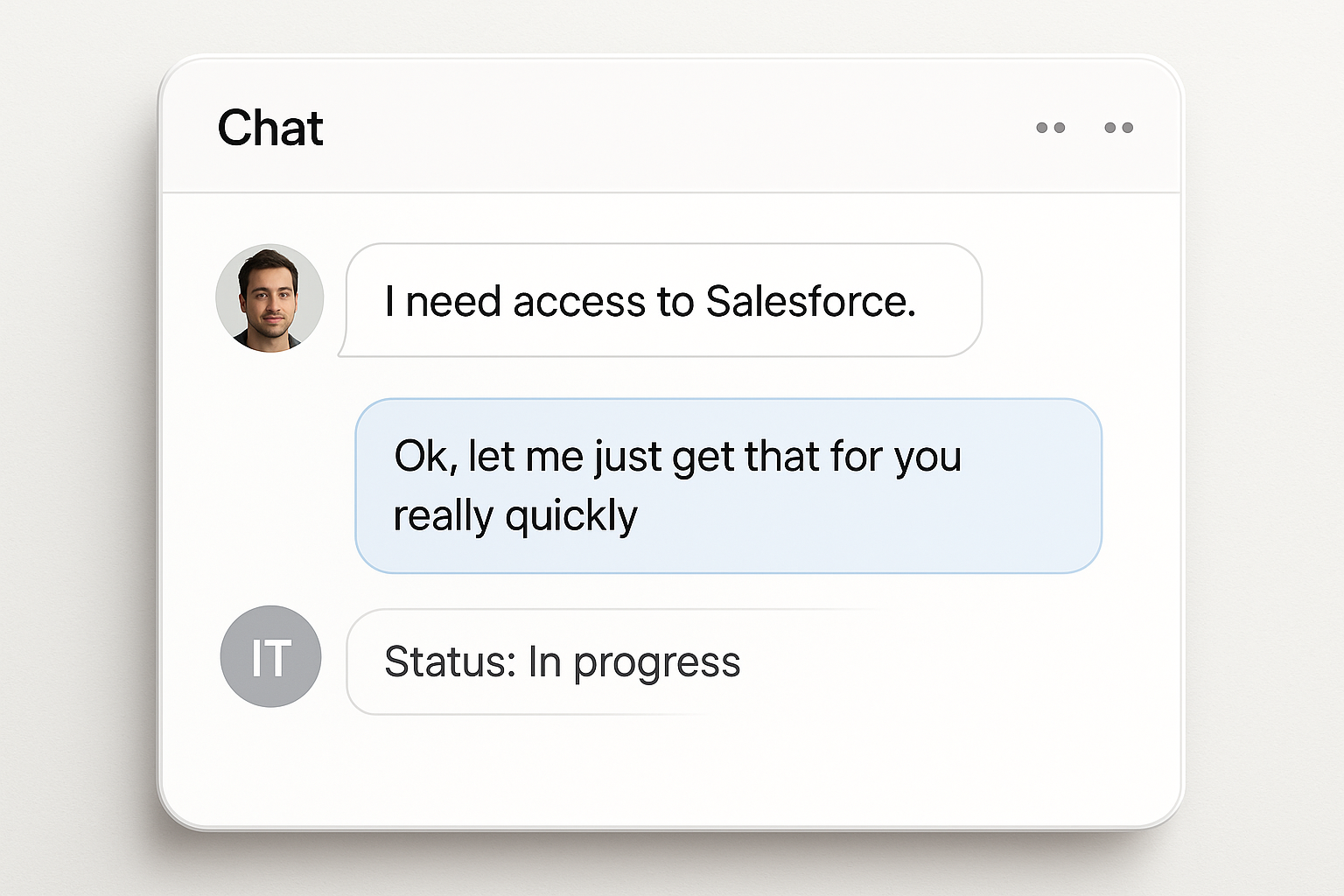
And yet, even in well-run organizations, users still do what they have always done. They send a message in Slack. They DM someone on the IT team. They reply to an old thread. They email a person instead of a queue. In other words, they choose the shortest path between a problem and another human being.
And yet, even in well-run organizations, users still do what they have always done. They send a message in Slack. They DM someone on the IT team. They reply to an old thread. They email a person instead of a queue. In other words, they choose the shortest path between a problem and another human being.

The Design Problem Nobody Wants to Admit
That dynamic is easy to misread as a training problem or a discipline problem. In reality, it is usually a design problem.
The modern employee does not experience work through a portal. They experience it through communication tools. Slack, Teams, email, and collaborative spaces have become the operating layer of daily work. Asking users to step out of that flow, navigate to a separate service environment, determine the right category, and complete a form before they can ask for help introduces friction at precisely the moment they are least willing to tolerate it.
That is why so many ticketing experiences fail to achieve the behavior they are designed to enforce. They are structurally sound, but behaviorally misaligned.
What Users Are Really Telling You
In our conversations with customers, this comes up with remarkable consistency. Even organizations with mature ITSM environments, established workflows, and well-documented intake policies still struggle with informal service requests. The reasons are rarely surprising:
- Forms can feel too generic or too long
- Users often do not know how to classify their problem
That is why so many ticketing experiences fail to achieve the behavior they are designed to enforce. They are structurally sound, but behaviorally misaligned.
What Users Are Really Telling You
In our conversations with customers, this comes up with remarkable consistency. Even organizations with mature ITSM environments, established workflows, and well-documented intake policies still struggle with informal service requests. The reasons are rarely surprising:
- Forms can feel too generic or too long
- Users often do not know how to classify their problem
- The portal may technically be available, but it is not where work is happening
- Most importantly, users are not actually trying to avoid process. They are trying to reduce effort.
This distinction matters.
When employees bypass the portal, what they are often signaling is not that they reject structure. It is that they prefer immediacy, clarity, and convenience. A message in chat feels immediate. It feels acknowledged. It allows the user to begin with the problem they understand, not with the workflow taxonomy IT has designed behind the scenes.
The Hidden Cost of Invisible Work
Of course, this creates real operational pain for IT teams. Unstructured intake leads to:
- Inconsistent triage
- Fragmented visibility
- Poor reporting
When employees bypass the portal, what they are often signaling is not that they reject structure. It is that they prefer immediacy, clarity, and convenience. A message in chat feels immediate. It feels acknowledged. It allows the user to begin with the problem they understand, not with the workflow taxonomy IT has designed behind the scenes.
The Hidden Cost of Invisible Work
Of course, this creates real operational pain for IT teams. Unstructured intake leads to:
- Inconsistent triage
- Fragmented visibility
- Poor reporting
- Hidden work that lives outside the system of record
Requests that begin in DMs are difficult to track and even harder to measure. A team can appear to be managing volume well while actually carrying a large amount of invisible work outside the system of record.
This is where many organizations get stuck. The portal is necessary for the team, but undesirable for the user. Chat is natural for the user, but operationally risky for the team.
The answer is not to keep trying to force one side to behave like the other. The answer is to close the gap.
A Better Way Forward
A better service model starts from a different premise: instead of asking how to drive all users into the ticketing system, ask how to make the ticketing system operate inside the environments users already prefer.
That means:
- Enabling requests in Slack or Teams
- Creating structured follow-ups only when needed
- Distinguishing between public and private request flows
- Ensuring that the operational record is created or synchronized automatically in the background
That approach does not eliminate the ticket. It simply changes where the ticket becomes visible.
The answer is not to keep trying to force one side to behave like the other. The answer is to close the gap.
A Better Way Forward
A better service model starts from a different premise: instead of asking how to drive all users into the ticketing system, ask how to make the ticketing system operate inside the environments users already prefer.
That means:
- Enabling requests in Slack or Teams
- Creating structured follow-ups only when needed
- Distinguishing between public and private request flows
- Ensuring that the operational record is created or synchronized automatically in the background
That approach does not eliminate the ticket. It simply changes where the ticket becomes visible.

In a modern service experience, the user does not need to think first about the tool. They start with the request. The system can then capture the necessary context, apply the right structure, route the work appropriately, and preserve the integrity of the service operation. IT still gets governance, reporting, ownership, and automation. The employee gets a service experience that feels natural.
The Mindset Shift
This is an important shift in mindset for IT leaders. The goal is no longer to teach users how to behave like service operators. The goal is to design service operations that align with how employees already work.
That is why the most successful teams are not the ones with the strictest portal rules. They are the ones that reduce the distance between a user's moment of need and the team's ability to respond in a structured way.
The underlying truth is simple: users do not dislike tickets as a concept. They dislike friction. And if friction remains the defining feature of the intake experience, they will continue to route around it.
The future of internal service is not less structure. It is better placement of structure. By meeting employees where they work—in Slack, Teams, and other collaboration tools—IT teams can maintain operational rigor while delivering a service experience that feels effortless.
Ready to transform your IT service delivery? Learn how Foqal brings structured ticketing into Slack and Teams, eliminating friction while maintaining full operational visibility.
Subscribe to our newsletter
Get the latest insights on IT operations, AI, and workplace productivity delivered to your inbox.
Ready to transform your support?
See how Foqal can help your team deliver faster, smarter support.
Start Free TrialRelated Articles
Why IT Teams Are Replacing Jira and ServiceNow
Discover why IT teams are shifting from traditional Jira and ServiceNow interfaces to friction‑less, chat‑based experiences that keep the powerful back‑end while dramatically improving user satisfaction.
The Problem with AI IT Support Bots
Discover why AI support bots often fall short and how a hybrid approach—combining AI‑driven knowledge retrieval with human‑guided workflows—can turn AI into a powerful accelerator for IT service delivery.
The Future of IT Onboarding: Fully Automated Day-1 Workflows
Discover how fully automated Day‑1 workflows transform onboarding from a chaotic checklist into a seamless, secure experience that boosts efficiency and showcases IT’s strategic value.